
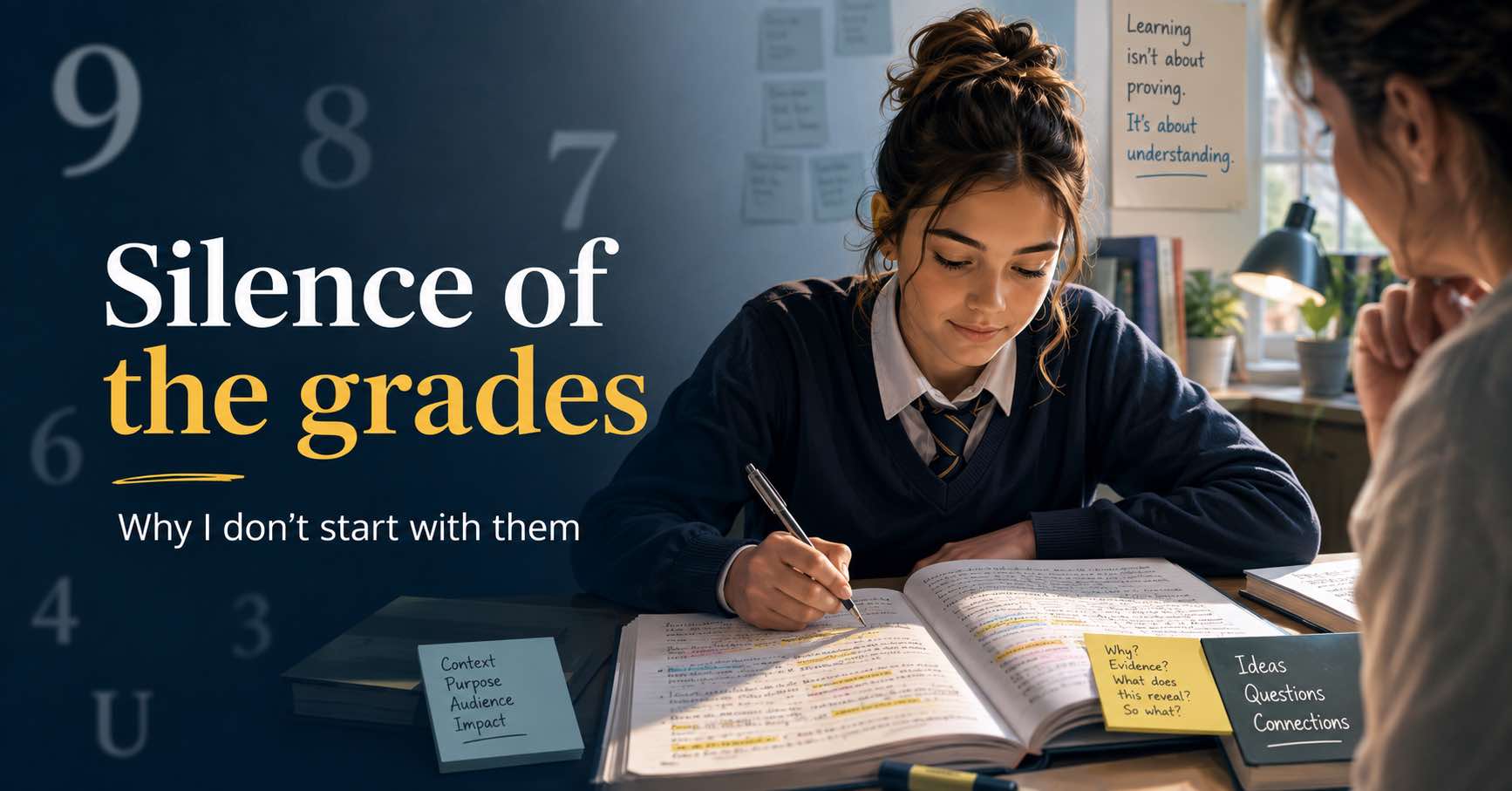
In the age of 1-9 GCSE grades, we often lose sight of the student behind the number. High scorers and those who fail have one thing in common: they’re branded with a digit while their effort stays invisible.
Grades are a great indication of the general level a student is working at. For example, aiming for a grade 8 means the student has above average skills. Grade 9 is exceptional. But what are they missing if they’re predicted a 6 or a 7?
More crucially, what are they struggling with if they are predicted a 4? A grade 4 is a passing grade, which means the student knows just enough that they don’t fail. It means they understand the message of fiction and non-fiction texts that use modern, everyday English. They can write about these texts in a coherent, clear way. This is a basic skill any society should expect from its soon-to-be voters.
Sadly, failing English Language is common: 40.3% of all students (that includes those who sat the exam for the first time and those who resit) failed their GCSE exam in 2025. This 40% is made up of grades U to 3, but what do these numbers tell us?
If a student scores a grade 3, do we know if it’s because they didn’t understand the text (a reading comprehension issue) or don’t know how to write analytically (critical thinking issue)? Or maybe they struggle with writing itself – the act of transferring thoughts to paper. This, in turn, has many components that can break: from the fine motor skill of holding the pen to dyslexia, and anything in between. Does a grade tell us which link in the chain needs fixing?
It doesn’t.
The record low pass rate of last year’s exam is of course an issue that’s way bigger than the question of grades. Arguably, those 40.3% of students who didn’t pass their exam were failed by a school system that only understands progress when it’s numeric.
Where does this leave us?
If a parent tells me “We’re expecting a [insert high or low grade, both are equally telling] but she’s struggling” that doesn’t give me much to work with, if anything at all.
I don’t blame parents, though. Grades are easily pictured as a goal to work towards, coveted by A-Level application forms, and frequently flaunted as the be all and end all of education.
The problem is that none of this is tangible.
Families rarely get enough feedback from the school/teacher to know exactly what they need to improve. It’s a rare delight when a parent tells me that their child’s teacher asked them to work on, say, PEE paragraphs. Great! That is a tangible, actionable piece of feedback, unlike “Student Y needs to work towards a solid 4.”
That’s not to say writing PEE paragraphs isn’t layered. It’s a huge task if you don’t know how to write a topic sentence, how to choose the right quotes, and how to come up with an idea to write about in the first place. But that’s okay because these are actual steps that I can show to and practice with the student. They will lead to a “solid 4.”
Maybe I don’t understand the fine nuances of grading – I’m sure there’s an art to it. But a 1-hour, focused session tells me way more than a single digit number ever could.
Misleading numbers and the impact of an hour
Learning a student’s current or predicted grade can be misleading. Take, for example, Student X. X’s mother reached out to me in March this year, asking for help for her son who was due to sit his GCSE in May. She told me that X was getting 2 & 3 consistently in tests, that he had low confidence, that she didn’t understand why he was struggling when he’s a “bright kid”. She asked me to help him pass English Language.
Knowing X was working towards a shaky Grade 4, I braced myself for crisis management: going back to basics, whistle stop tour of important techniques, inference practice, etc. It took 1 short extract and a 5-minute discussion during our first lesson for X to show that he has an excellent grasp of language (both grammar and syntax, which is rare) and that he can read between the lines. He was hesitant to speak, yes, but it wasn’t because he didn’t know the answers. There wasn’t enough time for me to find out exactly why: maybe he was worried of getting it wrong, maybe scared of my reaction, perhaps weighed down with bad experiences. Probably a combination of all of these.
But children blossom in a safe space. The moment X realised that the critical evaluation of his ideas isn’t a personal attack and that he is welcome to read, understand, and see things from his own unique perspective, he started to spill one wonderful analysis after the other.
The rub? He was never taught how to put his ideas on paper. Or rather, he was never shown the process in a way that made sense to him.
I didn’t really need to teach him anything apart from pointing out gaps in his written analysis. It took him no time to start writing coherent, logical, critically sound analyses with true insight.
I predict him a Grade 4+. Maybe he’ll get a 5 if it was too hot in the exam hall and he couldn’t focus. Maybe a 7. Maybe he had proper sleep the days before the exams and gets an 8.
What I do know is that Student X is ready to face the world of employment contracts and mortgage agreements and perhaps even the growing threat of misinformation and fake news. Not because of the pass grade he’ll get, but because of the skills he has regardless of the grade he gets.